01RACI / map
Stakeholder map
Decision-makers, users, system owners and their responsibilities.
Precise business rules, process models and system requirements that remove ambiguity before implementation or vendor selection.
Discuss this engagement ↗The engagement turns dispersed knowledge and assumptions into explicit, reviewable evidence.
Each artifact is tailored to the decision at hand. The examples below show the structure, not a fixed template.
Decision-makers, users, system owners and their responsibilities.
Current and target workflows with events, decisions, hand-offs and exceptions.
Core business concepts, relationships, ownership and terminology.
Functional behaviour, business rules, constraints and quality expectations.
Critical user and system flows, including alternative and failure paths.
Links between objectives, requirements, rules, tests and acceptance evidence.
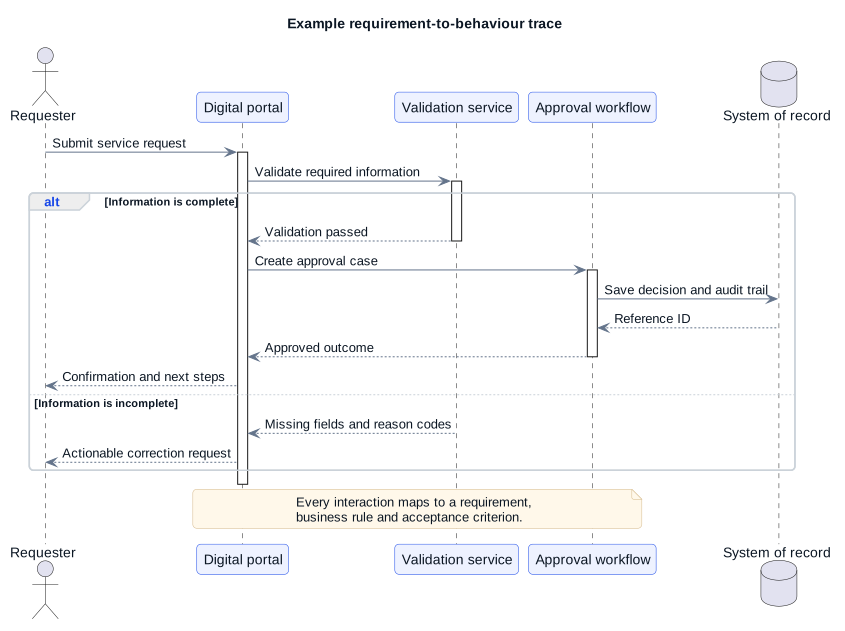
A representative PlantUML sequence showing how a business request becomes validated system behaviour and auditable outcomes.
A focused process that makes assumptions visible and keeps stakeholders involved in the decisions that matter.
Interview stakeholders and review existing processes, systems and evidence.
Visualise workflows, information, rules and system interactions.
Write testable requirements, constraints and acceptance criteria.
Resolve conflicts and secure shared stakeholder understanding.