01Opportunity matrix
Use-case portfolio
Candidate opportunities mapped by value, feasibility, urgency and risk.
A responsible AI adoption plan grounded in valuable use cases, available data, operating constraints and measurable success criteria.
Discuss this engagement ↗The engagement turns dispersed knowledge and assumptions into explicit, reviewable evidence.
Each artifact is tailored to the decision at hand. The examples below show the structure, not a fixed template.
Candidate opportunities mapped by value, feasibility, urgency and risk.
Assessment of data, technology, skills, governance and operating model.
Source availability, quality, access, sensitivity and ownership gaps.
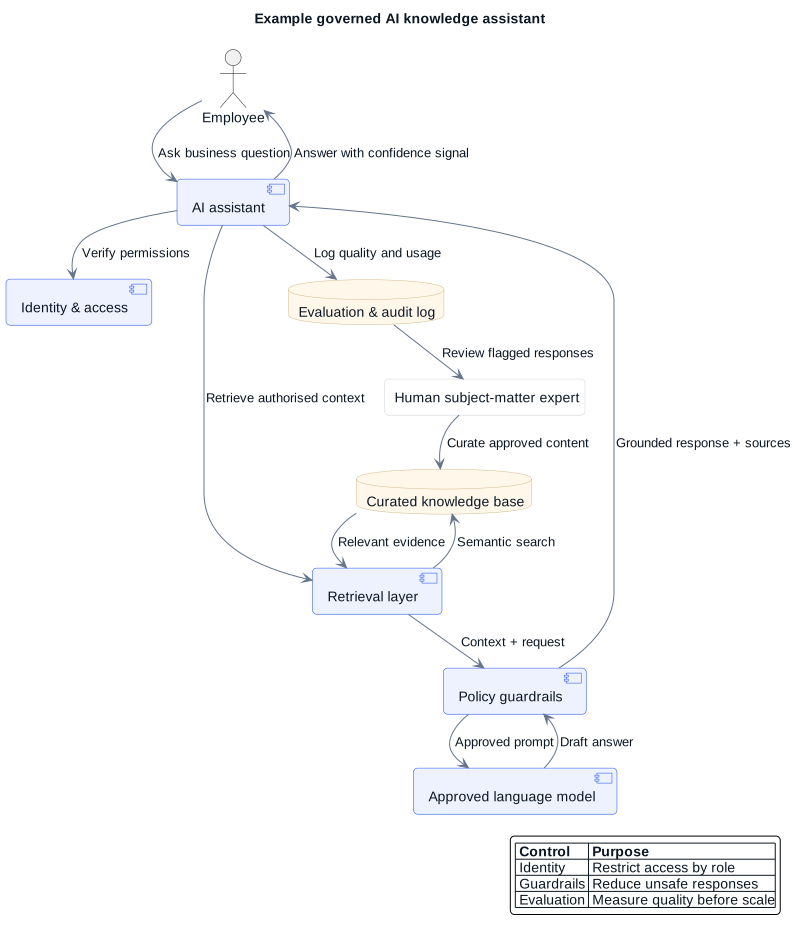
Conceptual AI flow with identity, retrieval, models, guardrails and monitoring.
Privacy, security, bias, hallucination, compliance and operational controls.
Sequenced experiments, decision gates, capability building and scale criteria.
A representative PlantUML architecture showing retrieval, permissions, guardrails, evaluation and human oversight.
A focused process that makes assumptions visible and keeps stakeholders involved in the decisions that matter.
Identify business challenges where AI could create measurable value.
Evaluate data, technology, governance, skills and change readiness.
Compare use cases through value, feasibility, cost and risk.
Define the pilot, controls, measures and responsible path to scale.